Ontological Engineering in Artificial Intelligence
This covers ontological engineering — the discipline of actually building, validating, and maintaining ontologies as production artifacts. It’s the difference between knowing what a bridge is for and knowing the engineering discipline that keeps it standing.
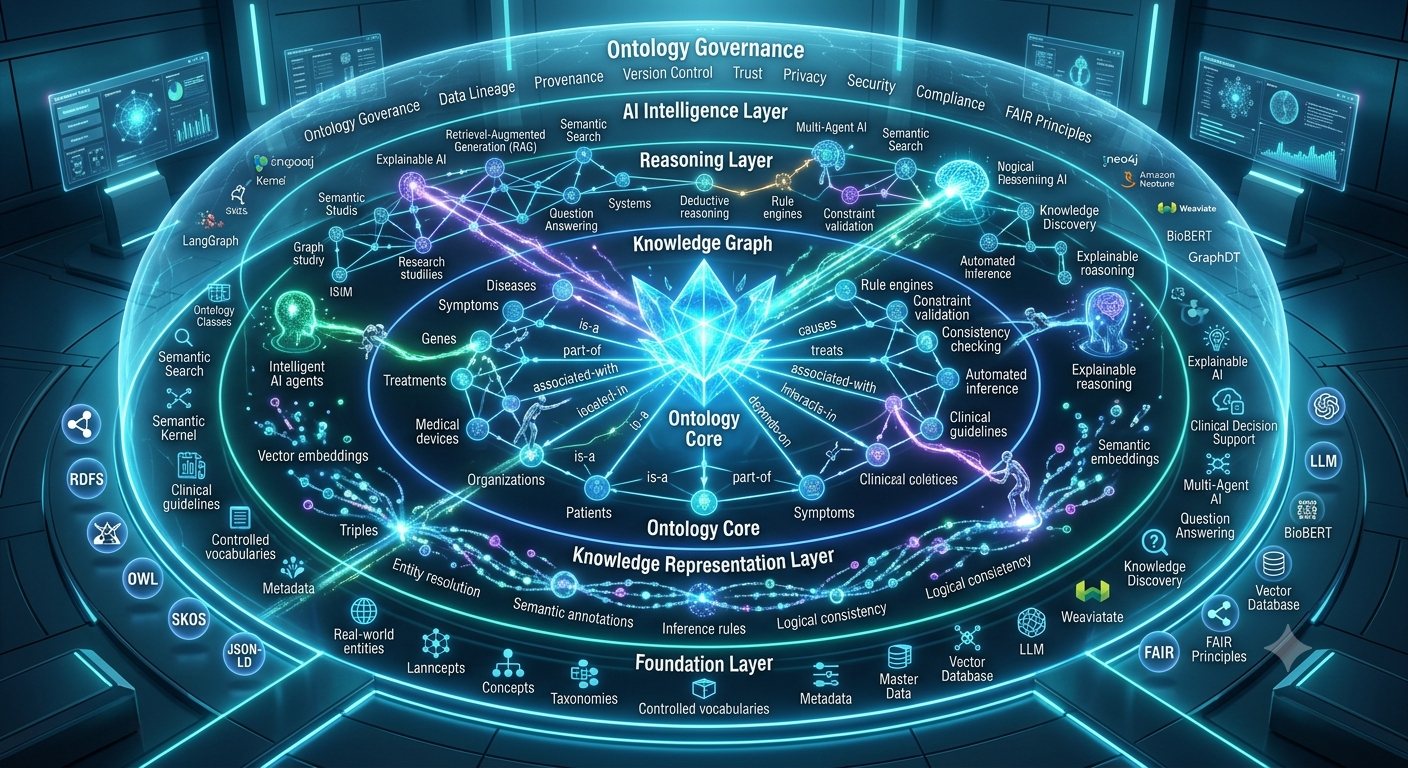
Ontological engineering is the systematic discipline of designing, implementing, governing, and evolving formal, machine-interpretable representations of knowledge. It bridges the gap between theoretical conceptualization and production-grade software engineering. In enterprise AI, an ontology is not merely a documentation artifact; it is a dynamic operational asset that enforces semantic consistency, formal logic, and validation rules across complex domains.
The Semantic Foundation for Agentic AI in Healthcare
Within a cloud-agnostic Agentic AI platform, ontological engineering establishes the foundational semantic layer required to orchestrate autonomous clinical AI. Healthcare ecosystems are inherently fragmented, relying on a mix of structured and unstructured standards including HL7, FHIR, DICOM, SNOMED CT, LOINC, and clinical text. Ontological engineering harmonizes these disparate schemas into a unified, coherent knowledge graph. This enables autonomous AI agents to move beyond surface-level keyword processing and instead achieve deep, contextual clinical reasoning, multi-agent collaboration, and deterministic decision-making.
In a Scaling Agentic AI in Healthcare Lakehouse powered by an Enterprise 5-Tier Medallion Data Architecture, ontological engineering functions as a core data-engineering capability. As clinical data progresses from raw ingestion to the semantic and consumption tiers, the ontology dynamically preserves and enriches the meaning of clinical entities, relationships, and medical workflows. By embedding semantic context directly into the data pipeline, the architecture provides a robust, compliant knowledge backbone that accelerates Retrieval-Augmented Generation (RAG), automated compliance auditing, provenance tracking, and safe enterprise-wide AI scaling.
Operationalizing Ontologies as Production Artifacts
To scale safely, ontologies must be managed with the same rigor as traditional software assets. Ontological engineering applies rigorous DevOps and data-governance principles—such as ontology design patterns, CI/CD-driven semantic validation, automated consistency checking, and terminology version control—to the knowledge lifecycle. This engineering discipline ensures that the enterprise knowledge model remains deterministic, extensible, and legally compliant as clinical guidelines, medical terminologies, and autonomous AI systems evolve.
1. What Ontological Engineering Actually Is
Ontological engineering is the applied discipline — methods, tools, and quality criteria — for specifying, building, and maintaining ontologies as reusable, verifiable artifacts, rather than as one-off diagrams or tribal knowledge in someone’s head. The term deliberately mirrors “software engineering”: the point is that ontology construction has a repeatable lifecycle, has failure modes that are predictable and preventable, and produces an artifact that has to be tested, versioned, and maintained like any other piece of infrastructure — not written once and left alone.
This matters because the default failure mode of ontology work in enterprises is treating it as a one-time modeling exercise (a whiteboard session, a diagram, a spreadsheet of terms) rather than an engineered artifact with a lifecycle. Ontological engineering exists specifically to prevent that failure mode.
An introduction to ontological engineering as a discipline — what it is, why it matters, and the practical considerations for enterprise adoption. Includes the representation/tooling stack, evaluation methods, LLM integration, and common pitfalls.
You're reading it →The history, lifecycle, methodologies, and nine foundational principles that establish the baseline prerequisites for engineering production-grade knowledge layers — from formal conceptualization and multi-level stratification to formalization and operational embodiment.
Learn more →How ontologies function as the semantic backbone for AI agents and LLMs — tool/function grounding, multi-hop reasoning, disambiguation, guardrails, and multi-agent semantic interoperability. Includes the full raw-data-to-meaningful-understanding pipeline and enterprise architecture integration.
Learn more →A curated survey of active research on ontology-grounded agentic AI — neurosymbolic enterprise agents, hallucination mitigation via knowledge graphs, GraphRAG, automated ontology construction with LLMs, and multi-agent semantic interoperability protocols.
Learn more →Architectural primitives for non-deterministic software — the routing layer, validation layer, and ontological engineering as the semantic substrate for agentic AI, AI agents, multi-agent orchestration, LLMs, and explainable AI.
Learn more →2. Foundational Design Principles
See the dedicated page on Foundational Design Principles for the nine foundational principles that establish the baseline prerequisites for engineering production-grade knowledge layers.
3. The Representation and Tooling Stack
| Layer | Standard / Tool | Purpose |
|---|---|---|
| Lightweight taxonomy/thesaurus | SKOS | Controlled vocabularies, concept hierarchies, synonym/related-term relations — often the right starting point before jumping to full OWL |
| Formal ontology language | RDF / RDFS / OWL (Lite, DL, Full profiles) | Classes, properties, and increasingly expressive axioms; OWL DL is the usual sweet spot — decidable reasoning without OWL Full’s undecidability |
| Constraint validation | SHACL | Shape-based data validation — often more practically useful than OWL reasoning for enforcing enterprise data-quality rules |
| Query | SPARQL (RDF) / Cypher or Gremlin (property graphs) | Retrieval and competency-question testing |
| Editors | Protégé / WebProtégé, TopBraid Composer | Ontology authoring, with built-in reasoner integration |
| Reasoners | HermiT, Pellet, FaCT++ | Automated consistency checking and classification |
| Ontology quality scanning | OOPS! (Ontology Pitfall Scanner) | Automated detection of common modeling anti-patterns |
| Alignment / matching | OAEI benchmark tools, LogMap, AgreementMaker | Mapping concepts across independently built ontologies — the tooling layer for federation across standards like SNOMED and a vendor-specific schema |
The practical decision most enterprise teams get wrong is reaching for full OWL-DL expressivity and reasoning by default. In practice, SHACL-based constraint validation plus a lighter SKOS/RDFS concept hierarchy resolves the majority of real grounding problems for agentic systems, with far less ongoing maintenance burden than a fully axiomatized OWL ontology with active DL reasoning.
4. Evaluation: Verification vs. Validation
These are distinct activities and conflating them is a common mistake:
- Verification asks: is the ontology internally consistent? This is mechanical — run a reasoner (HermiT, Pellet) and check for unsatisfiable classes or contradictory axioms. It catches logical errors but says nothing about whether the ontology is actually useful.
- Validation asks: does the ontology correctly model the domain, and does it answer its competency questions? This cannot be fully automated — it requires domain-expert review, and running the competency questions as literal queries against populated instance data to confirm they return correct results.
A well-formed but unvalidated ontology is a common and quietly dangerous failure mode: it passes every automated check while modeling the domain incorrectly, because reasoners can only catch logical contradictions, not factual or conceptual ones. Automated pitfall scanners like OOPS! sit between these two activities — they catch known anti-patterns (like OntoClean violations) that pure logical consistency checking misses, without requiring full human review for every check.
5. How LLMs Are Reshaping the Discipline
What’s genuinely changing: the labor-intensive front half of the lifecycle — term extraction from unstructured text, candidate relation discovery, first-draft competency-question generation, and even first-pass OWL/RDF axiom drafting — is increasingly LLM-assisted. Multi-agent pipelines that assign separate LLM agents to extraction, schema alignment, and validation roles are outperforming single-model approaches on this work, and interaction frameworks like OntoScope are formalizing LLM-assisted scoping — using structured LLM dialogue to help a human define ontology boundaries, rather than trying to have the model define them unsupervised.
What isn’t changing: the verification/validation gate. Every credible methodology and every serious construction pipeline in the current research keeps human or reasoner-based validation as a hard requirement, not an optional step — for a structural reason, not a cautious one: an LLM validating its own ontology extraction reintroduces exactly the hallucination risk the ontology was built to eliminate for the downstream agent. The engineering discipline hasn’t gotten shorter; the automatable fraction of it has gotten larger.
A practical implication for enterprise practice: the lifecycle doesn’t change shape under LLM assistance — Specification and Evaluation remain human-owned, Conceptualization and Formalization become substantially LLM-accelerated, and Implementation and Maintenance become a hybrid where LLM-proposed changes flow through the same governance gate as human-proposed ones.
6. Enterprise Ontological Engineering: Practical Considerations
- Federate, don’t reinvent. For a domain with an existing standard — clinical data has SNOMED CT/LOINC/HL7 FHIR, finance has FIBO, supply chain has GS1 — the ontology-engineering task is alignment and extension, not ground-up construction. Treat NeOn-style reuse as the default, and reserve original modeling effort for the genuinely enterprise-specific slice of the domain.
- Scope to one bounded domain first. Enterprise-wide ontology programs that try to model everything before proving value on one department or use case are the most common cause of stalled initiatives — this is a lifecycle problem (Specification done too broadly) more than a tooling problem.
- Govern like code, not like documentation. Versioning, deprecation policies, and change-impact analysis need the same rigor as a schema migration, because a silently stale concept definition causes an agent to reason incorrectly without throwing any error.
- Keep the SHACL shape and the agent tool schema as one source of truth. A SHACL constraint and a JSON tool-call schema enforcing the same rule should be mechanically derived from one definition, not maintained as two independently-edited artifacts that can quietly drift apart.
- Budget for maintenance from day one, not just construction — an unmaintained ontology degrades in the same slow, hard-to-detect way an undocumented schema does, except the failure surfaces as an agent’s silently wrong reasoning rather than a broken pipeline.
7. Common Pitfalls
- Specification skipped or rushed — modeling starts before competency questions exist, producing an ontology that’s technically valid but doesn’t answer the questions it needs to.
- Conflating verification with validation — a reasoner returning “consistent” is treated as sufficient proof the ontology is correct, when it only proves the ontology is not self-contradictory.
- Rigidity violations — accidental properties (
Student,ActivePatient) modeled as superclasses of essential ones (Person), which reliably causes classification errors once a reasoner or agent scales up usage. - Reinventing reference ontologies — building a custom clinical or financial concept hierarchy from scratch instead of extending SNOMED CT or FIBO, which quietly breaks interoperability with every other system correctly using the standard.
- Treating ontology as a one-time deliverable — no versioning policy, no deprecation process, no owner — the same failure mode as unmaintained software, except harder to detect because the symptom is subtly wrong reasoning, not a crash.
- Unsupervised LLM-generated ontologies — skipping the human/reasoner validation gate on LLM-proposed structure, which reintroduces the hallucination risk one layer up.
8. A Practical Minimal Workflow
For a team starting a new ontology-engineering effort inside an existing enterprise architecture:
- Write competency questions first — 10–20 concrete questions the ontology must answer, agreed with domain experts before any modeling begins.
- Check for an existing reference ontology or standard covering the domain — assume reuse is possible until proven otherwise.
- Conceptualize informally — glossary and relationship sketch, reviewed by domain experts who don’t need to read OWL.
- Formalize at the lowest sufficient expressivity — SKOS/RDFS/SHACL before reaching for full OWL-DL with active reasoning, unless the domain genuinely requires complex class-level inference.
- Run an OntoClean pass on the core taxonomy before implementation, specifically checking rigidity violations in the upper levels of the hierarchy.
- Implement and populate with real instance data early — an ontology that’s only ever been tested against toy examples will surface its gaps in production, not before.
- Verify with a reasoner, then validate against the original competency questions as literal queries — both gates, not just the automatable one.
- Version and assign ownership before declaring the first release done — maintenance policy is part of the deliverable, not a follow-up task.
Ontological engineering is what turns “we should have an ontology” into an artifact that survives contact with real data, real domain experts who disagree with each other, and — increasingly — real autonomous agents making decisions against it. The discipline predates generative AI by three decades, which is exactly why it’s worth applying with its full rigor rather than reinventing a lighter version of it under agentic-AI branding: the failure modes it was built to prevent (unscoped models, unvalidated taxonomies, unmaintained artifacts) are the same failure modes that show up as silent agent misbehavior today.